March 26, 2026
The School of Medicine (SOM) of University of Health and Allied Sciences (UHAS) formed faculty research groups as part of its efforts in strengthening research capacity, fostering multidisciplinary research collaboration among faculty and enhancing scholarly outputs.
In a brief but significant ceremony held on Thursday, June 12, 2025 at the School to officially launch the initiative, an electronic tablet was presented to each Head of Department (HoD), while Team Leaders received an electronic tablet and a laptop each. The initiative which is being supported by Stanbic Bank Ghana with an initial donation of 10 laptop computers, 20 electronic tablets, two 85-inch television sets and one high-quality video camera, all valued at over GH₵300,000.00, aimed at boosting academic productivity with digital access.
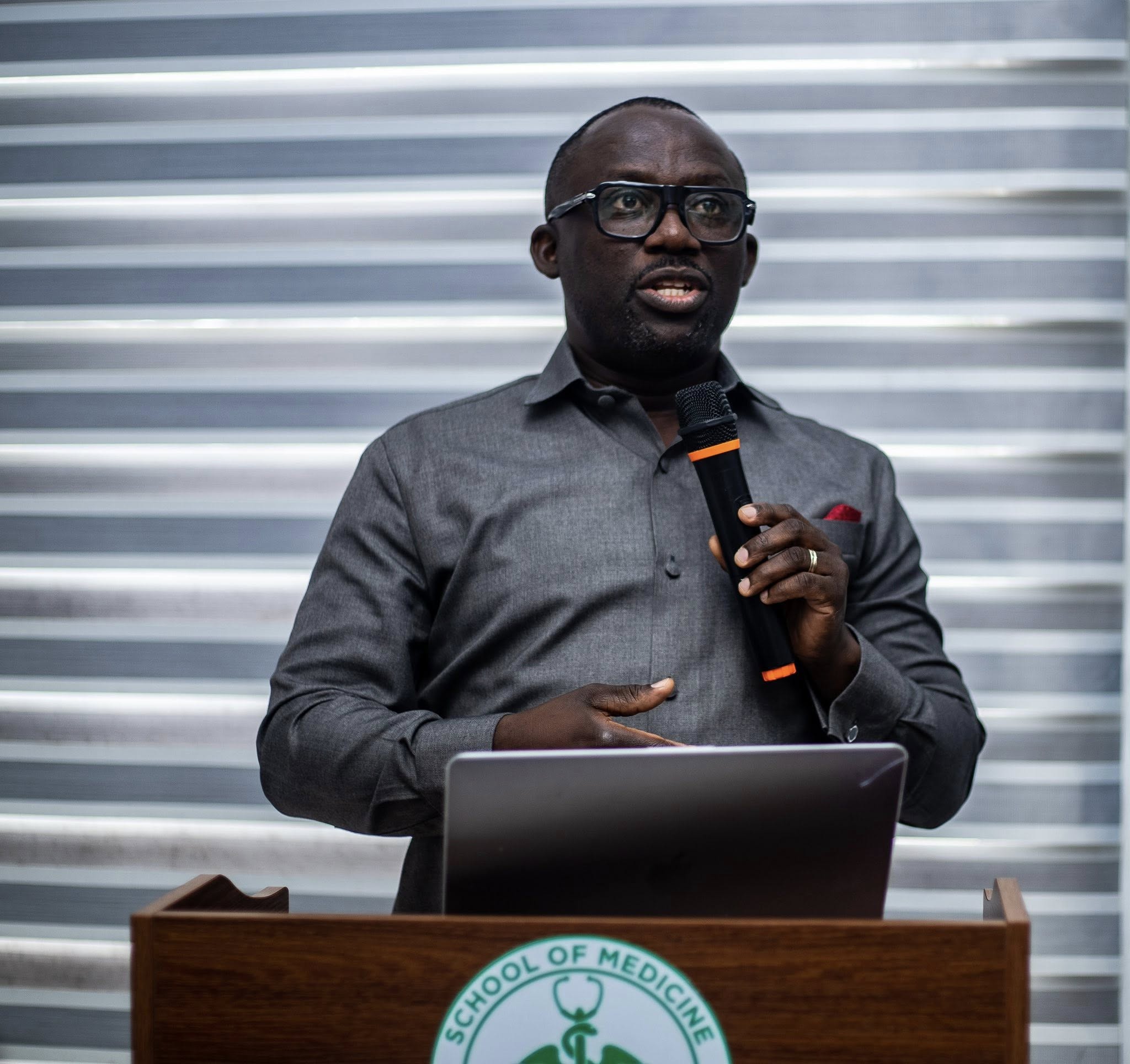
In his welcome address, Professor Yaw Awuku, Dean of UHAS-SOM, among other things, explained that the initiative was primarily to deepen collaborative research efforts among faculty of the School. Professor Awuku showcased the operational document for the research groups which outlined thematic areas and projects to be undertaken over a three-year period. He encouraged each group to identify relevant national health challenges and conduct structured, problem-based research, citing the Hepatitis Evaluation to Amplify Treatment (HEAT) model as one of the data measurement frameworks that could be adopted.
The Pro-Vice Chancellor, Professor Frank Edwin who chaired the brief ceremony highlighted the importance of collaboration in research, emphasizing the fact that ‘One is too small a number to attain significance.’ He appreciated the exemplary gesture of Stanbic Bank Ghana and also underscored the value of the use of technology in health research. The Pro-Vice Chancellor urged the faculty to put the electronic gadgets to good use. He lauded the School’s efforts towards empowering its faculty in undertaking research and called attention to the need for budgeting for device maintenance as a means of sustaining the initiative.
Professor Edwin encouraged the faculty to deeply reflect on their research goals and be strategic in their collaborations by engaging across disciplines. He reiterated the importance of curiosity, methodological rigor and knowledge-sharing, urging all faculty to “check best practices across groups” as they pursue excellence in research.
Professor Verner Ndudiri Orish, HoD of Microbiology and Immunology and one of the team leaders, described the formation of the research teams as ‘a step in the right direction’. He advocated the need for a sustained commitment to grant applications and active participation in multidisciplinary group research. He urged faculty members to set clear goals and collaborate not only within the School of Medicine but also with other
units of the University, such as the Fred N. Binka School of Public Health (FNBSPH) and the Institute of Health Research (IHR) to increase the chances of publishing impactful research works.
Dr. Raymond Saa-Eru Maalman, HoD of Basic Medical Sciences and a team member expressed profound gratitude to the leadership of UHAS-SOM for the initiative. He was hopeful that the initiative would go a long way to improve research and teaching outcomes within the School in particular and UHAS in general.
UHAS continues to place a premium on research as a core pillar of its mission and remains committed to supporting initiatives that position the University as a centre of excellence in health education and research in the sub-region.